How to Fix an Undercooked Pizza Base: Rescue It Now
Is your pizza base undercooked? Discover quick fixes to ensure a perfectly crispy crust and enjoy your meal with confidence!
An undercooked pizza base is usually safe for most healthy adults to eat in small amounts, but the smarter move is to finish it with heat before serving. Lift a slice, check the underside, and if it’s pale, doughy, or bends without resistance, get it back onto a hot surface immediately. Here’s what to do right now:
- Slide it onto a preheated skillet or baking steel over medium-high heat for 3–4 minutes. This is the fastest, most reliable fix.
- Return it to a very hot oven (250°C / 480°F or higher) directly on a stone or steel for 3–6 minutes if the whole pizza needs rescuing.
- Discard it without eating if you’re in a high-risk group (pregnant, elderly, immunocompromised, or feeding young children) and the dough is visibly raw in the center.
The reason these methods work: sustained direct heat dries out excess moisture and gelatinizes the starches in the dough, converting that gummy, raw texture into a set, crisp crumb.
Key Takeaways
An undercooked pizza base is almost always fixable with direct heat, and almost always preventable with a few consistent prep habits.
| Point | Details |
|---|---|
| Best immediate rescue | Slide onto a preheated skillet or steel for 3–5 minutes; cover loosely with foil to protect toppings. |
| Top prevention habit | Pull dough from the fridge 1–2 hours before baking and preheat stone or steel for 60 minutes. |
| Safety rule | High-risk groups (pregnant, elderly, young children, immunocompromised) should not eat undercooked dough. |
| Root cause to fix first | Cold dough at launch and excess sauce moisture cause most soggy bases; address both before the pizza goes in. |
| Doughdorks option | Pre-cooked Neapolitan bases and 48-hour fermented dough balls remove the most common failure modes for home bakers. |
Table of Contents
- How can you tell if a pizza base is undercooked?
- Step-by-step fixes to rescue a doughy pizza right now
- Is it safe to eat an undercooked pizza base?
- Why does a pizza base stay undercooked? The root causes
- How to avoid an undercooked base next time
- Ready dough and pre-cooked bases: a practical option for consistent results
- Doughdorks pre-cooked bases and ready dough skip the troubleshooting entirely
- Sources
How can you tell if a pizza base is undercooked?
The underside tells you almost everything. Lift a slice by the crust end and look at the bottom. A properly baked base should be golden to deep brown with some char spots. A pale, white, or grey underside means the bottom heat never did its job.
Beyond color, press the center gently with a finger. A cooked base springs back. A soggy pizza base sinks and stays compressed, sometimes leaving a slight indentation. Pull a slice and watch the cut edge: if you see a translucent or white stripe running between the dough and the sauce layer, that’s the gum line, a gelatinous band of undercooked starch that forms when steam condenses against a cool sauce layer. Tap the base with a knuckle. A hollow sound suggests a set crumb; a muffled, dense thud points to dough not cooked through.
For a precise read, an instant-read thermometer inserted into the thickest part of the crust should hit around 96°C (205°F) before the starches are fully set. Below that, the center is still gummy regardless of how the top looks.
The gum line is the most misread sign of an undercooked base. Many home cooks assume the pizza is done because the cheese is bubbling and the edges are brown. The gum line sits hidden beneath the sauce and only reveals itself when you pull a slice. Check it every time.
Pro Tip: Cold dough launched straight from the fridge bakes unevenly because the center stays cool longer than the edges. If your pizza consistently shows a pale center and a browned rim, dough temperature at launch is almost certainly the cause, not your oven.
Step-by-step fixes to rescue a doughy pizza right now
Work through these in order. The first option is fastest and protects the toppings best.
-
Skillet or baking steel finish (best option). Place a cast-iron skillet or baking steel over medium-high heat. Slide the pizza directly onto it, no oil needed. Cover loosely with foil to trap heat above while the bottom crisps. Check after 3 minutes. Most bases firm up within 4–5 minutes. This method works even when the oven is already off.
-
Return to a very hot oven on stone or steel. Crank the oven to its maximum temperature (about 250°C / 480°F). If you have a pizza stone or baking steel, it should already be in there. Slide the pizza directly onto the hot surface and bake for 3–6 minutes, checking every 90 seconds. The direct contact with a preheated surface is what drives bottom heat.
-
Short grill/broil finish. Move the rack to the lowest position and switch to the grill/broil setting. Place the pizza on a preheated heavy pan and grill for 2–3 minutes. Watch it constantly. This works well when the top is already done and you just need the base to catch up.
-
Air fryer rescue. Set the air fryer to 200°C (390°F). Place one or two slices in the basket and run for 3–4 minutes. The circulating hot air crisps the base quickly without drying out the toppings too badly. This two-stage approach is one of the more practical options in a home kitchen.
What not to do:
- Don’t microwave the pizza hoping for a crisp finish. Microwaves heat water molecules and make the base softer, not firmer.
- Don’t add more sauce or oil to a soggy base thinking it will help. More moisture makes it worse.
- Don’t try to rescue a pizza that’s been sitting at room temperature for more than two hours.
Pro Tip: If your oven has an obvious hot spot (one corner that browns faster), rotate the pizza to that corner for the last 2 minutes of the rescue bake. That concentrated heat finishes the bottom faster than the center of the oven rack.
Is it safe to eat an undercooked pizza base?
Raw pizza dough carries two real risks: raw flour and, in some cases, active yeast. Raw flour is an agricultural product that can harbor pathogens like E. coli or Salmonella before heat kills them. This is not a theoretical risk. The UK Food Standards Agency advises against eating raw or undercooked dough and batter for this reason.
Most healthy adults who eat a small amount of slightly undercooked pizza dough will experience nothing worse than mild digestive discomfort. The risk scales with how raw the dough is and how much is eaten. A gum line in an otherwise baked pizza is a different level of concern than a visibly raw, wet center.
The groups who should avoid undercooked pizza dough entirely:
- Pregnant people
- Young children under five
- Adults over 65
- Anyone who is immunocompromised or on immunosuppressive medication
If someone in these groups has eaten a significant amount of raw dough and develops severe vomiting, bloody diarrhea, or a high fever within 24–72 hours, seek medical attention promptly. For healthy adults, mild nausea that resolves within a few hours is unlikely to need medical care, but persistent or worsening symptoms warrant a call to NHS 111.
Reheating a partially cooked pizza to a full internal temperature of 75°C (167°F) throughout the base does reduce pathogen risk, but it is not a guaranteed substitute for proper baking from the start.
Why does a pizza base stay undercooked? The root causes
Understanding what went wrong makes the fix obvious and the prevention permanent.
- Cold dough at launch. Dough pulled straight from the fridge is dense and cold in the center. It takes longer to cook through, and the outside often browns before the inside sets. Pro kitchen guidance consistently points to this as the most common cause of the gum line.
- Excess moisture from sauce, cheese, or toppings. Watery sauce soaks into the dough before heat can set it. Fresh mozzarella releases significant liquid during baking. Wet vegetables (mushrooms, courgette, spinach) steam from the inside. Sauce moisture is a primary driver of a soggy pizza crust.
- The gel layer. When steam from wet toppings condenses against a cool sauce layer, it forms a white, gummy stripe between the dough and sauce. Research-style testing identified this gel layer as the structural cause of soggy centers, and found that a long preheat of the baking surface is the most reliable way to prevent it.
- Insufficient bottom heat. A cold stone, a stone preheated for only 15 minutes, or a pizza baked on a room-temperature tray all fail to deliver the burst of bottom heat the base needs in the first 60–90 seconds of baking.
- Overloading the oven. Baking two pizzas at once, or placing a second pizza on a stone that hasn’t recovered its heat, drops the surface temperature significantly. The base never reaches the temperature needed to set.
- High-hydration dough baked too fast. Very wet doughs (above 65% hydration) need longer, more controlled heat to drive off moisture. A fast, very high-heat bake can set the outside while leaving a gummy center.
Draining fresh mozzarella overnight or switching to low-moisture mozzarella removes one of the biggest moisture contributors before the pizza even goes in the oven.
How to avoid an undercooked base next time
Most undercooked pizza problems are solved before the pizza goes in the oven, not during baking.
Prep checklist:
- Pull dough from the fridge at least 1–2 hours before baking. Room-temperature dough stretches more evenly and cooks through faster. Proper proofing makes a measurable difference in the final bake.
- Bring sauce to room temperature before spreading. Cold sauce locally cools the center of the pizza and creates a condensation zone that traps moisture.
- Use less sauce than you think you need. A thin, even layer is enough. Drain canned tomatoes before blending.
- Pre-cook watery vegetables (mushrooms, peppers, courgette) in a dry pan before topping.
- Leave a small bare ring of dough around the center to allow steam to escape from the edges.
Equipment and setup:
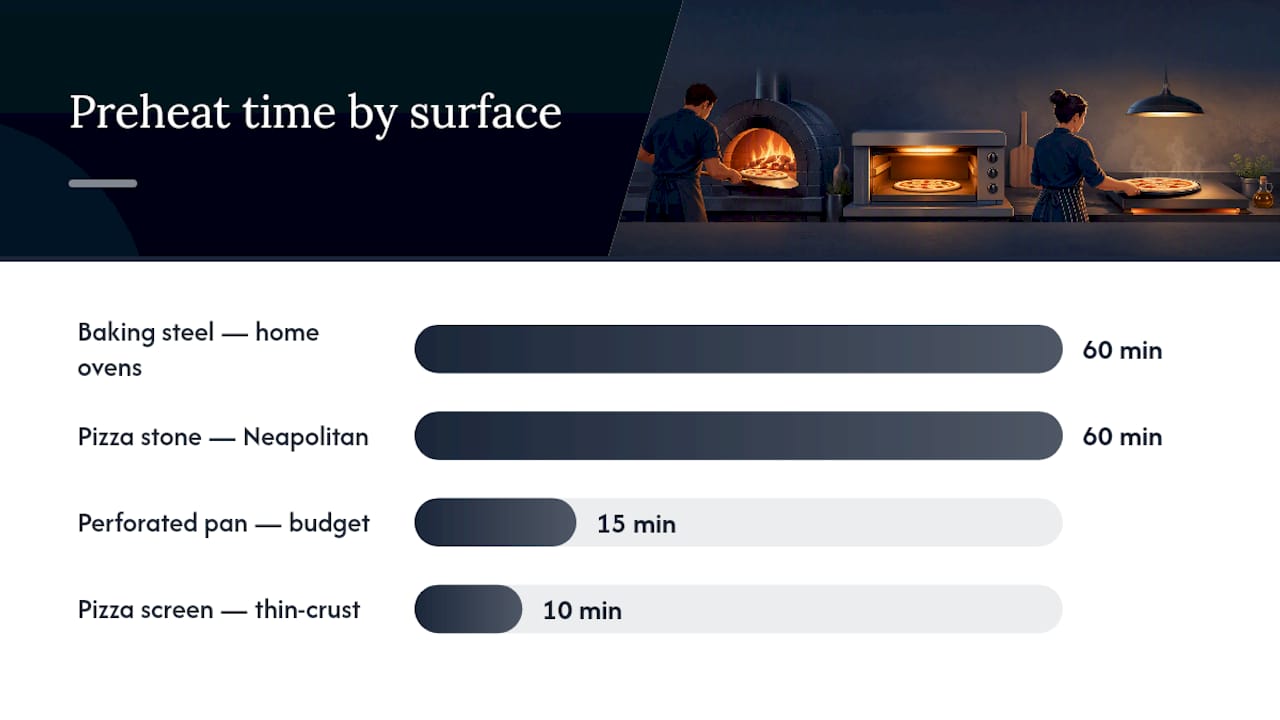
| Surface | Preheat time | Best for |
|---|---|---|
| Baking steel | 60 minutes | Fastest bottom heat, home ovens |
| Pizza stone | 60 minutes | Classic Neapolitan results |
| Perforated pan | 15 minutes | Budget option, good steam venting |
| Pizza screen | 10 minutes | Thin-crust, quick bakes |
An oven thermometer is worth having. Most domestic ovens run 15–25°C cooler than their dial suggests, which explains a lot of undercooked bases. Place the thermometer on the rack you’re baking on and adjust accordingly.
For heavy toppings (lots of cheese, dense meat, multiple vegetables), par-bake the base for 4–5 minutes before adding anything. This sets the bottom before moisture from toppings can penetrate.
Pro Tip: Wait 3–5 minutes between pizzas when baking more than one. A stone or steel loses significant thermal mass after each bake. Skipping the recovery time is one of the most common reasons the second pizza comes out with a soggy base even when the first was perfect.
Longer cold fermentation also helps. 48-hour fermented dough develops a stronger gluten structure that resists collapse and holds its shape under wet toppings better than same-day dough.
Ready dough and pre-cooked bases: a practical option for consistent results
Pre-cooked bases and properly fermented ready dough remove the two failure modes that cause most undercooked pizza problems at home: cold dough at launch and insufficient bottom heat.
- Pre-cooked bases arrive already baked through. You add toppings and finish in a hot oven for 8–12 minutes. There’s no raw center to worry about, no gel layer to form, and no need for a preheated stone. They’re the fastest route to a pizza that’s guaranteed cooked through.
- 48-hour fermented dough balls from Doughdorks are made with Italian 00 flour, fresh yeast, and extra virgin olive oil. The long fermentation builds a gluten network that bakes more evenly and resists the gummy center that plagues same-day doughs. Let the ball come to room temperature for 1–2 hours, stretch, top, and bake.
- Ready-made options suit situations where you have limited equipment, limited time, or you’re cooking for a group and can’t afford an undercooked result. The full guide to using pre-cooked bases covers finish-bake times and topping tips in detail.
For UK buyers, Doughdorks delivers across the country. The pre-cooked bases collection includes both packs of four and packs of eight, depending on how many pizzas you’re planning.
The one habit that changed how pro kitchens handle undercooked bases
The single most impactful change in professional pizza kitchens isn’t equipment. It’s timing. Staging dough to room temperature before service, and keeping a designated hot spot in the oven for finishing bases that need more bottom heat, eliminates the vast majority of undercooked results without changing anything else.
In a home kitchen, this translates directly: pull your dough out early, know which corner of your oven runs hottest, and use it deliberately. Rotate the pizza to that spot for the last 2 minutes of every bake. It takes no extra equipment and costs nothing, and it’s the difference between a pale, doughy base and one that’s properly set.
Doughdorks pre-cooked bases and ready dough skip the troubleshooting entirely
If you’ve read this far and the honest answer is that you’d rather not manage dough temperature, oven hot spots, and preheat timings every time you make pizza, that’s a completely reasonable position.

Doughdorks pre-cooked Neapolitan pizza bases arrive already baked, so the base is never the variable. Add your toppings, finish in a hot oven, and you’re done in under 15 minutes with no risk of a raw center. For home cooks who want to work with fresh dough, the 48-hour fermented dough balls are made with Italian 00 flour and cold-fermented for two days, giving you a base that bakes evenly and holds up under wet toppings far better than anything you’d make same-day. Both options ship across the UK. Order at Doughdorks and have everything you need for your next pizza night delivered to your door.
Sources
- How to Fix a Soggy Pizza Bottom | JayArr Pizza | JayArr Pizza
- Knead to Know: Avoid an Undercooked Pizza and Unhappy Diners - Pizza Today
- Why Is My Homemade Pizza Soggy in the Middle? - LetsFoodie
- Why Pizza Sauce Makes Dough Soggy and How to Fix It - Backyard Oven
- Doughy Pizza: How to Fix Undercooked Crust and Get Perfect Texture
Recommended
- Ready Made Pizza Bases Guide for Better Pizza - Dough Dorks
- Authentic Pre-Cooked Neapolitan Pizza Bases (Pack of 8) | Dough Dorks
- Apple Pay
- Best Cheeses for Pizza: A Home Cook’s Guide
READY-MADE • PART-BAKED • UK DELIVERY
Skip the stretching. Buy pizza bases ready to top.
Pre-made Neapolitan pizza bases, made fresh to order from 48-hour fermented dough and part-baked. Top, bake and eat.
-
 Ready-Made Neapolitan Pizza Bases – Pack of 4
From £14.40
Ready-Made Neapolitan Pizza Bases – Pack of 4
From £14.40
-
Ready-Made Neapolitan Pizza Bases – Pack of 8
From £27
Handmade in Dorset • Free UK delivery over £50 • Free proofing pot with every dough ball